The Isms
I. Dynamism - psychic force; impersonal power; the theory that force or energy is the basic principle of all phenomena.
A. Animate and inanimate objects and natural phenomenon are viewed as not only sacred happenings, but as normal events.
B. Some non-living objects possess a high degree of force or power (called mana among Pacific Islanders).
a. If you think this is superstition, remember that you came to campus on such objects. They don't move and still they have enough force to make your day pleasant of to make you surrender and go home, instead of come to school. Their names are I-15 and The 78!! Fog can stop us in our tracks, too, so it has impersonal power over us. The list of such things is endless. In the Native world there were as many such things - rivers, hail, mountains, snow, bad water, heat, certain plants, earthquakes, droughts, tornados, and so forth.
C. Impersonal power can be gained, increased, or lost.
1. Taboo is a social rule (usually a restriction) maintained to: 1) avoid loss of the source of impersonal power and 2) to restrict the uninitiated populations (non-shamans) from contact/contamination/danger. It also serves to prevent destruction of resources by controlling the behavior of the community.
a. In California it was taboo for any one to pick cactus fruit, and many other resources including salmon, until enough was available to feed everyone in the community a ceremonial portion. Once the First Fruit ceremony was held and everyone ate together and was sated, then anyone could go and pick. This kept the resources from being stripped, it moderated competition to prevent hostilities, and it made sure everyone had a full belly and a lot of fun!
D.
Dynamism is neither good nor bad but it can affect both.
E. Magic - a means of harnessing dynamism.
1. Magic always involves cause and effect.
2. Magic is neither good nor bad but can be used toward either.
3. Magic requires two assumptions:
a. Like causes like; homeopathic; imitative.
b. Things which have once been in contact with one another continue to affect each other, even at a distance; contagious.
4. Magic is not religion because it does not require interaction with a Goddess, Creator, Great Spirit, Deity.
a. Supernaturals can also be ghosts and spirits which are not sacred nor deities. So not all supernaturals are deities but all deities are supernaturals.
F. Shamans usually controlled the dynamistic forces of nature.
1. There were usually specific shamans who dealt with specific phenomenon.
a. A shaman might harness the dynamistic power of the eagle, whirlwind, rattlesnake, black widow spider, or certain plants with special healing qualities.
b. To learn all of the magic, preparations, and treatments of any shaman took at least twenty years of apprenticeship.
c. Shamans were not self-declared, people recognized them for who they were and sought them out.
d. Because they were connected with such powerful elements, shaman often were of outcasts and required to live alone, far from other people, where they would not contaminate the unwary.
e. Sometimes shamans were selected because they had previous psychic breaks with reality, as a high fever or near death experience, but had returned to normal functioning.
f. Gender and sexuality were taken into account. Both men and women served their communities as shamans.
i. Trans people might be more apt to be selected because they contained both male and female energy and thus were called "two-spirit."
II. Animism - belief in souls and spirits; the “vital principle.”
A. Souls can leave the body temporarily or permanently.
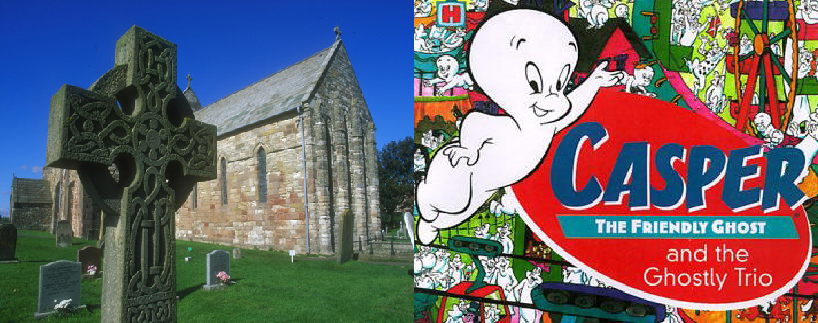
B. Souls can congregate. Like Casper and the Ghostly Trio.
C. Ancestor worship is one type of animism.
1. Rituals are done for love of ancestors.
2. Rituals are done because ancestors can influence happenings in this realm.
III. Totemism - special relationships that exist between individuals or groups and a certain plant, animal, and/or natural phenomenon.
A. The association can be secular or sacred.
1. The totem of Palomar is secular. Do you know what it is?
B. The totem is symbol, emblem, badge, social function.
1. Myths of origin may contain reference of the totem.
C. The totem is sometimes sacred, as when related to a special person with mystical powers.
1. Examples from Western culture of people with mystical powers include Jesus, Mohammad and Buddah. The cross and crescent are totemic symbols.
Test your knowledge of totems - Click to Take the TOTEM Quiz.
IV. Dualism - A concept which acknowledges the dual nature of existence. Hint: Dual means "two" (2).
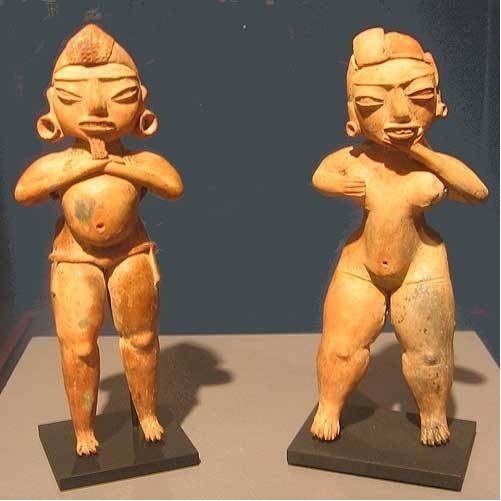 Male and female are two commonly opposed pairs
- part and counterpart to each other.
Male and female are two commonly opposed pairs
- part and counterpart to each other.
A. All parts have a counterpart. We think of them as opposites.
1. light/dark, white/black, life/death, man/woman, animate/inanimate,
hard/soft, big/small,
 ,
etc.
,
etc.
B. People, too, have a dual nature.
1. happy/sad, awake/asleep, good/bad, alive/dead, placid/angry, kind/mean, patient/impatient, timely/tardy, robust/weak, fat/skinny, etc.
2. There is a continuum for each of these pairs and we all may slide along each continuum throughout our lives. The intersection of the various continua at the place we are at represents who we are as individuals. Where we are positioned on any continuum is dependent on our personality, for sure, but also on the taboos of our culture. It is very rare that any person is all the way to one end or the other, most of us fall in between somewhere. Clearly someone is the "most" masculine or "least" feminine person alive, however, humans all run both "male" and "female" hormones through their systems and these levels change with age. None of us is purely male or female based on our biology - even religion accepts that male and female are made of the same exact ingredients.
C. Our dual nature requires expression.
1. This can be accomplished through action with the assistance of material objects. Masks and costumes are frequently used to express dualism.
a. Put masks on the dead to simulate life.
b. Masks are worn in ceremonial situations. We ask, “What or who are you,” not “Who are you pretending to be,” on Halloween.
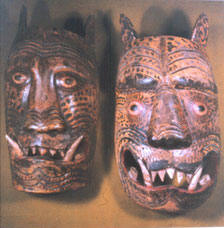
| These are jaguar masks worn by performers in Mexico who hope to be infused with the spirit of the jaguar. |
 |
2. We all have special days that denote duality.
D. Frequently we rely on religion as a format for the expression of dualism.
1. J.C. is the prime western example of dualism in religion.
E. We use uniforms to create an artificial duality or separation between the uniformed and the ununiformed.
1. We can repeat mechanical lies, "Bye-bye, it's been a pleasure serving you."
2. We can exercise authority over others.
3. We find comradeship with other uniform wearers.
F. Some expressed dualism requires transformation into deities.